Haem.io
Clinician-facing decision support for haematology

The intelligent layer betweenclinicians, labs and pharma

Transparent criteria execution aligned to WHO 2022, ICC 2022 and ELN risk stratification, built for clinician review in the genomic era.

Clinician-verified inputs
WHO + ICC 2022
ELN Risk Aligned
No black box logic
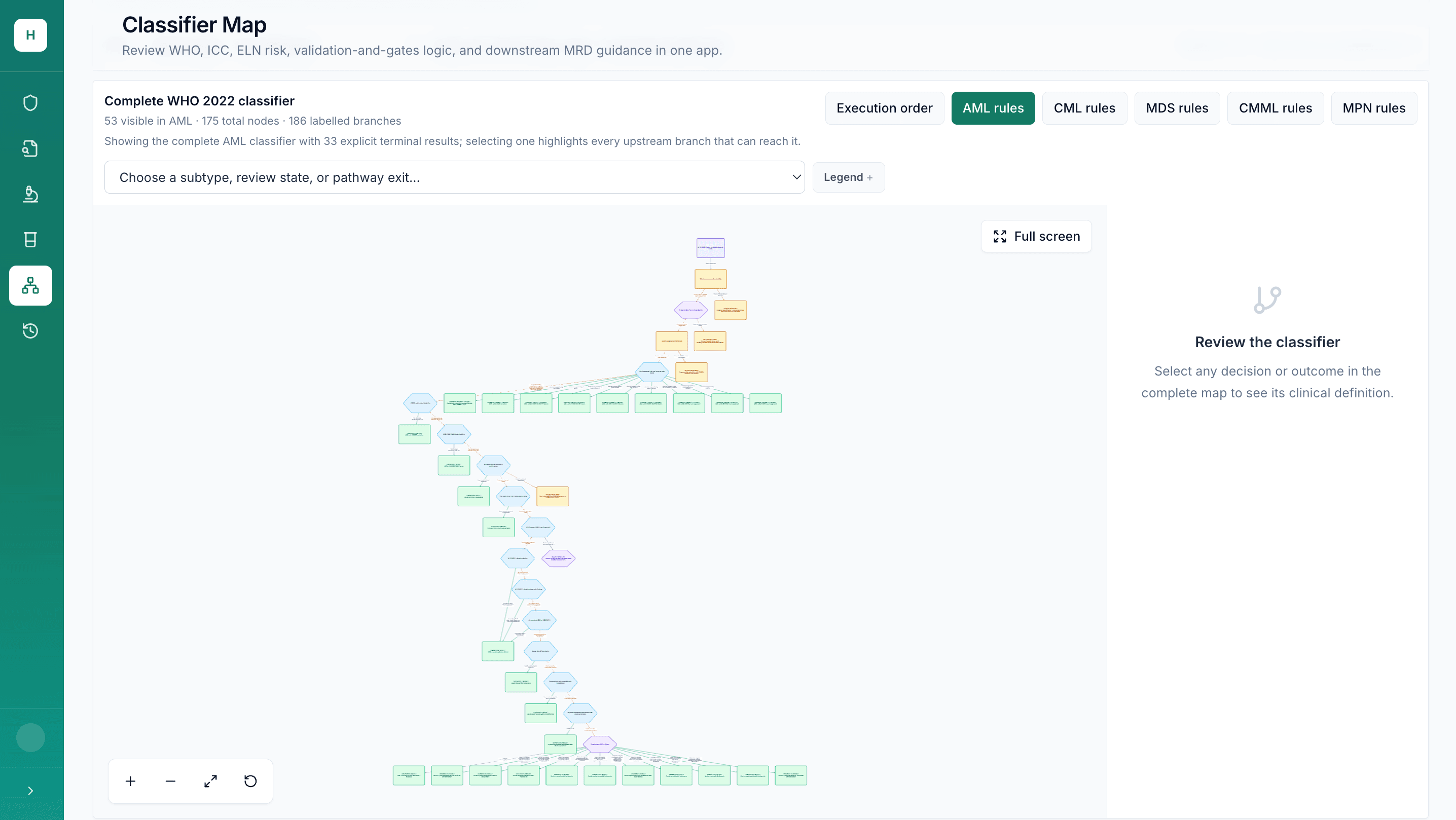
ICC 2022 execution path showing the full criteria decision tree

How Haem.io Works

A transparent three-step criteria review workflow

01

Structure

Turn case findings into a clinician-reviewable structured profile.

Report findings can be entered manually or structured for review. Mutations, cytogenetics, blast counts, and flow markers remain visible so clinicians can verify the input before criteria are applied.

02

Map

Apply WHO, ICC, and ELN criteria to produce a traceable review output.

Dual-framework criteria mapping against WHO 2022 5th Edition and ICC 2022. Every decision node is traceable with full reasoning chains visible.

03

Review

Support clinician review with classification context, risk logic, and rationale.

Displays risk stratification and supporting rationale where configured. Outputs are decision support for qualified clinicians and do not replace local governance or professional judgement.

See Inside the Platform

From report upload to trial matching — every step is transparent, traceable, and clinician-verifiable.

01

Upload a report, or enter data manually

Enter structured findings directly, or use a report workflow to prepare key haematology findings for clinician review: mutations, VAF, cytogenetic abnormalities, blast percentage, and clinical qualifiers.

  • Supports structured review of report findings
  • Detects mutations with variant allele frequency
  • Identifies cytogenetic abnormalities and karyotype
  • Extracts blast counts, flow markers, and clinical context
Report workflow showing structured findings from a TP53 case report
02

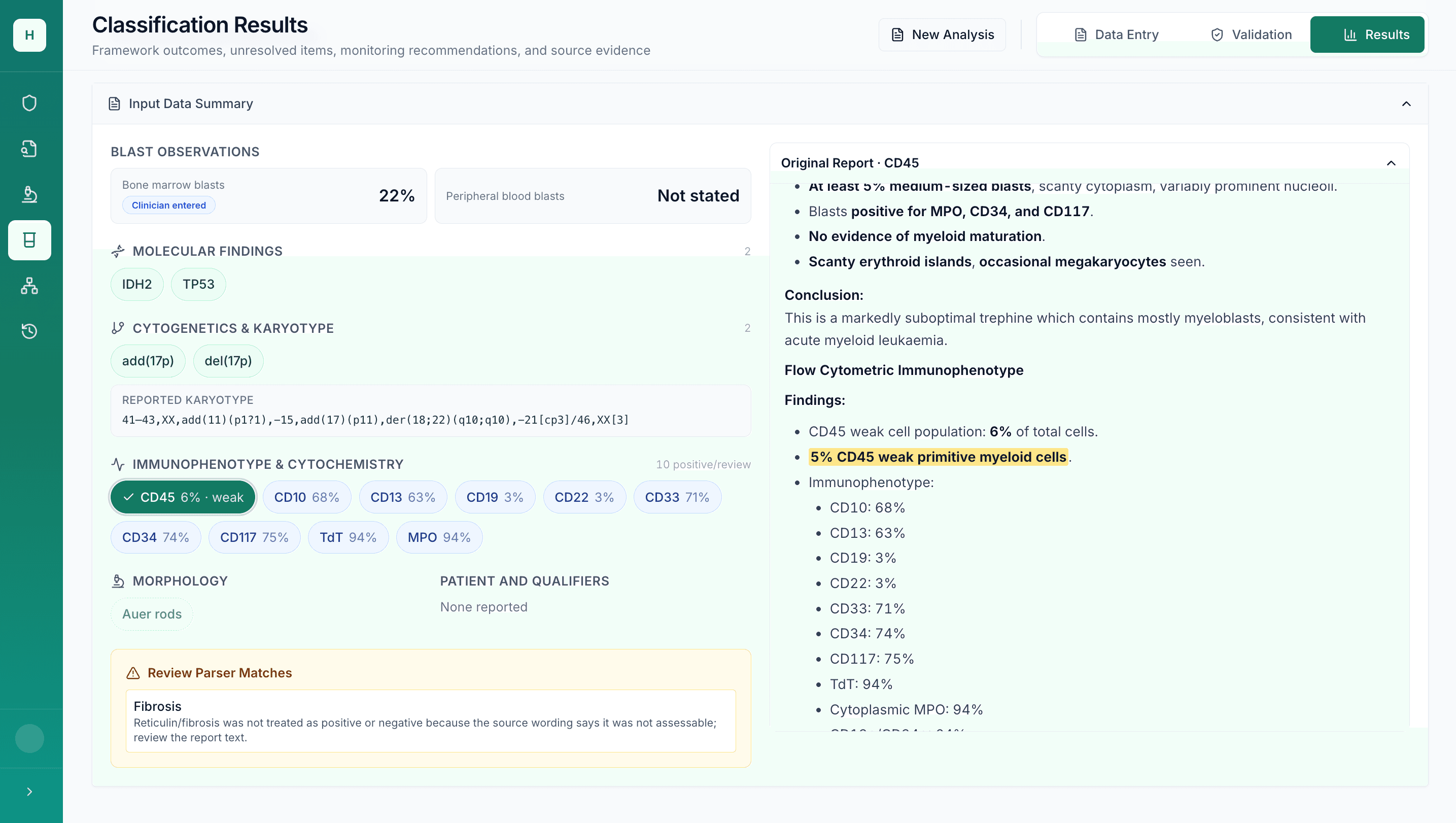
Review the structured data

Every parsed or entered value is displayed in a structured summary alongside the source material. Clinicians can check, correct, and confirm the data before criteria are applied. Nothing is a black box.

  • Side-by-side view: parsed data vs original report
  • Genetic mutations with classification significance flags
  • TP53 allelic status detection (LOH, del17p, multi-hit)
  • Cytogenetic complexity and myeloid-related abnormalities identified
Data inspector showing parsed mutations (TP53, DNMT3A, TET2, ASXL1), cytogenetics, and original report
03

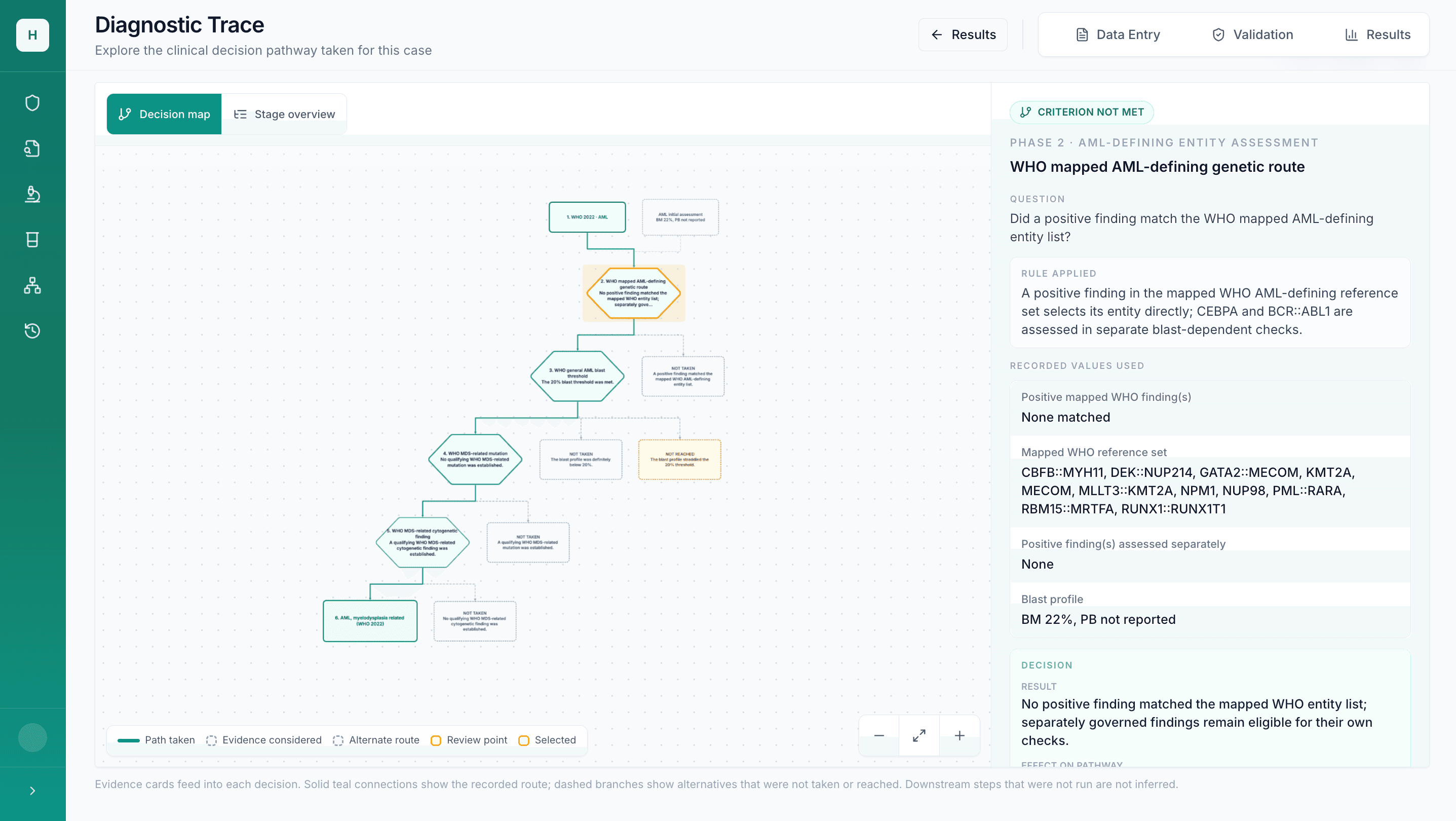
See the full criteria pathway

Haem.io runs clinician-confirmed case data through every decision node in the WHO 2022 and ICC 2022 classification trees. The result is not just a label: it is the complete execution path showing exactly which rules fired and why.

  • Full decision tree visualisation for WHO and ICC
  • Every branch point shown: which passed, which failed
  • Traceable reasoning with no hidden logic
  • Dual classification: WHO 2022 5th Edition + ICC 2022
ICC 2022 execution path showing the complete criteria decision tree with highlighted route
04

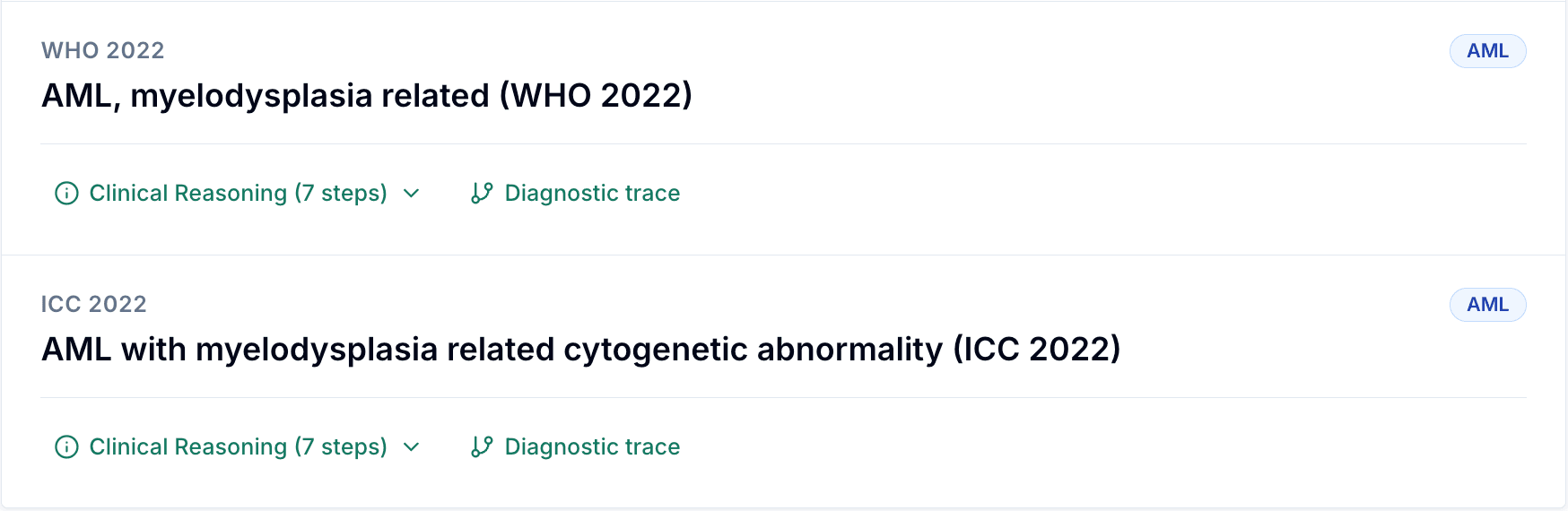
Dual-framework classification with full reasoning

Haem.io displays WHO 2022 and ICC 2022 classification outputs side by side for clinician review. Each result includes the complete reasoning chain: every rule evaluated and every decision explained.

  • WHO 2022 5th Edition and ICC 2022 results side by side
  • Clinical reasoning steps numbered and explained
  • Final pathway derivation from blast percentage to genetic findings
  • TP53 multi-hit evaluation with allelic status logic
Classification results showing WHO 2022 and ICC 2022 with clinical reasoning traces
05

Risk stratification and clinical decision support

Where configured, Haem.io applies ELN 2022 and ELN 2024 risk logic. Each risk category includes the calculation chain and supporting context so clinicians can verify every step.

  • ELN 2022 intensive and ELN 2024 non-intensive risk
  • Median overall survival estimates
  • Calculation steps visible and auditable
Risk stratification showing ELN 2022 Adverse and ELN 2024 Adverse with median survival
06

Clinical trial matching support

Based on classification context, genetics, and case profile, Haem.io can surface potentially relevant clinical trials for review. Each match shows eligibility signals and what additional data is needed to confirm suitability.

  • Matches against curated UK trial database
  • Eligibility signals (high, needs data, ineligible)
  • Shows what extra information would refine the match
  • Direct links to trial registries and contact details
Clinical trial matching showing eligible trials with confidence scores
0%
Visible Rule Traceability
0
Classification Frameworks
0
NHS Endorsements
<0min
Demo Review Flow

Supported by Leading NHS Clinicians

Senior haematologists across the UK are supporting Haem.io's validation work and clinician-led adoption pathway.

"Haem.io has the potential to transform diagnosis and decision making for patients with haematological malignancies across the NHS."

Prof Charles Craddock CBEChair, UK AML Research NetworkUniversity of Warwick

"Haem.io has the potential to revolutionise the quality of care that patients receive."

Dr John ChadwickConsultant HaematologistThe Christie NHS Foundation Trust

"A real step forward in what technology can offer in supporting clinicians to make accurate clinical diagnoses."

Dr Tom CoatsHaematology ConsultantRoyal Devon & Exeter NHS Trust

"I would wholeheartedly recommend this platform. This will be of significant use for clinicians in the front line."

Dr P A CahalinConsultant HaematologistBlackpool Teaching Hospitals NHS Trust
Education Platform

Haem.io Learn

Master WHO 2022 and ICC 2022 haematology classification through guided lessons, real case practice, and daily challenges — built by clinicians, for clinicians.

  • Structured AML & MDS classification modules
  • Daily practice with real case reports
  • ELN risk & IPSS-M stratification training
  • Track streaks, earn certificates
Start Learning Free
WHO2022 Aligned
ICC2022 Aligned
ELNRisk Scoring
FreeTo Access

Ready to modernise criteria review?

Try the interactive leukaemia classification support workflow. No login required.